Sooner or later every transfer company asks the same question. Should we keep selling through the big online transfer marketplaces, or put the effort into our own website? People often answer it as if you must pick one side. In practice most companies end up using both, and the useful question is how much of your business should come from each one.
What marketplaces do well
A marketplace already has the thing a new website does not: travellers looking for a transfer. You do not have to buy advertising, build a reputation from nothing or persuade a stranger to trust a company they have never heard of. If you have vehicles standing idle, a marketplace can fill them from the first week, and there is little to set up.
That is worth real money, especially when you are new to a region or expanding into a new airport. It is reasonable to pay for it.
What you give up
The cost is more than the commission, although you should start there. Read your contract and work out what you actually keep after commission, payment deductions and any penalties. Then look at the things that do not appear on the statement:
- The customer is not really yours. Often you get just enough detail to do the job. When the same family travels next year, they go back to the marketplace, not to you.
- You compete on price. Your car appears in a list next to others, and the list is usually sorted in a way that rewards being cheap.
- The rules can change. Commission, ranking, cancellation terms and payment timing are decided by someone else, and they can change while you are in the middle of a season.
- Your brand barely shows. A good ride builds the marketplace's reputation at least as much as yours.
What your own site does well
On your own site the booking is yours. You set the price, you keep the passenger's details and you decide what happens next. A passenger who has used you once can book again directly, and a hotel that sees your name on a proper website will take you more seriously than one that only sees a phone number.
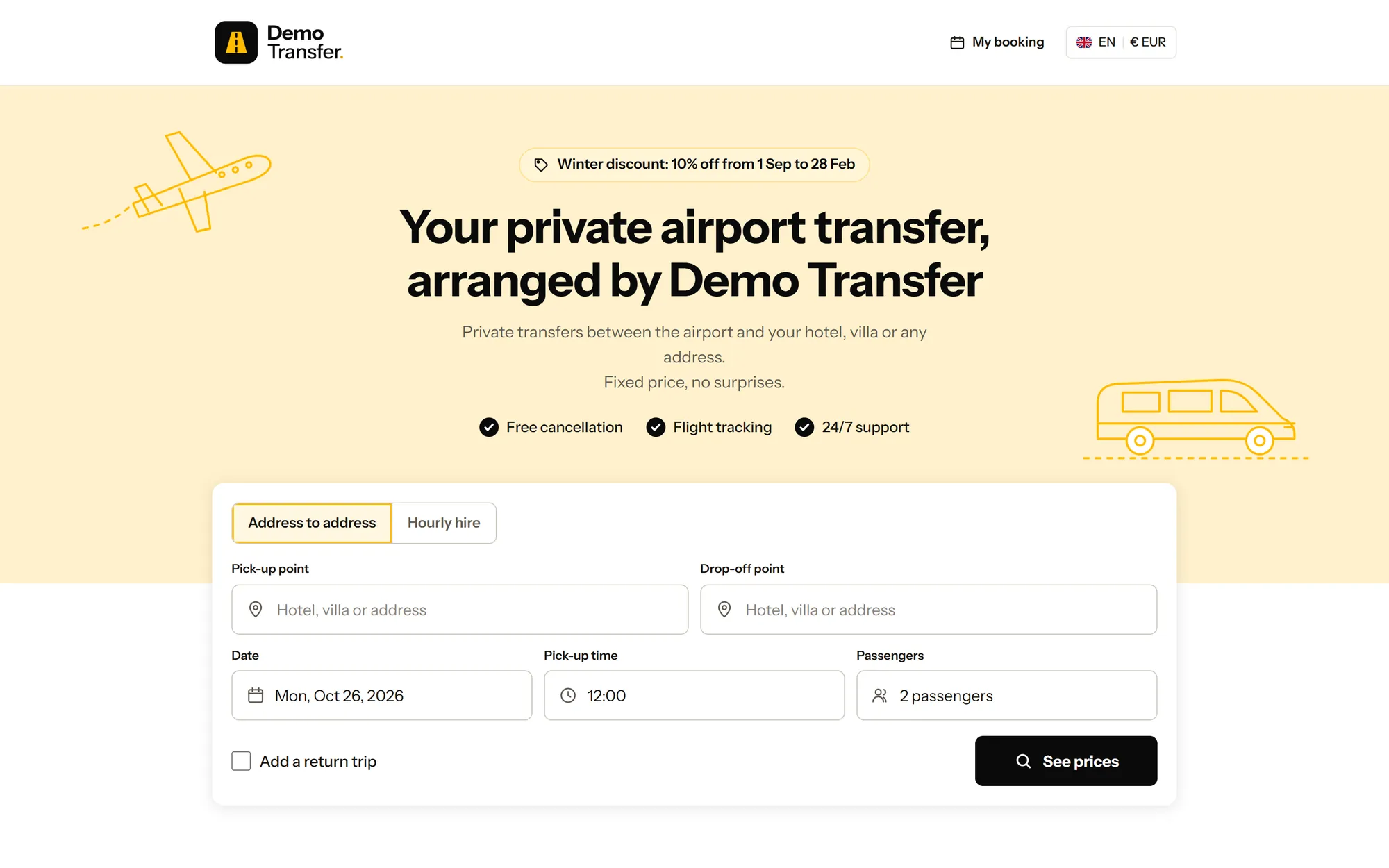
It also changes the sums. There is no percentage on each booking, so a busy month costs you the same as a quiet one. With a booking site for your transfer company, passengers choose the route, see a fixed price and book without calling you, even when your office is closed.
What your own site does not do
A website does not bring visitors by itself. This is where people get disappointed. On the day it opens, nobody knows it exists. Traffic comes from your Google profile, from links shared on Instagram and WhatsApp, from word of mouth, from hotels you work with and, if you choose to pay for it, from advertising. All of that takes time or money, and advertising can cost more per booking than a marketplace commission if it is badly run. A quiet first few weeks is not a failure, it is what you should expect.
You also carry more of the work. Questions, changes and complaints come straight to you. For a well-run company that is no bad thing, but you do need someone to answer.
How to decide with your own numbers
Skip general advice and take last month's figures:
- Write down how many bookings each channel brought you: marketplaces, website, phone, hotels and agencies.
- For each channel, work out what you kept per booking after commission, advertising and payment costs.
- Count how many passengers booked with you more than once. If you cannot count them, that is a finding too.
- Ask how you would cope if your biggest channel cut your bookings in half next month.
The last question matters most. If one marketplace brings nearly all your work, your problem is not its commission. It is that someone else's decision could empty your calendar. Keep these figures and repeat the exercise in a few months, so you can see the direction and not just one snapshot.
Running both without chaos
Most companies should keep what works and grow their direct share slowly. A few habits make that much easier:
- Keep every job in one place. A marketplace job and a website job need the same driver and the same calendar. Enter marketplace and phone bookings by hand in the same panel your website bookings land in, so nothing clashes.
- Start where a link costs nothing. Put your booking link on your Google profile, your Instagram bio and your WhatsApp replies from the first day.
- Win the repeat customer honestly. Check your marketplace contract first, because some forbid approaching their passengers. Your own customers, and anyone who contacts you directly, are a different matter: give them your link.
- Bring your partners in. Hotels and agencies are often your steadiest direct income. A booking portal for hotels and agencies lets them book at agreed prices without calling you.
- Measure before you spend more. Once you run advertising, reports that show where each booking came from tell you which spending is worth repeating.
When a marketplace alone is fine
If you are small, your vehicles are full and you have no wish to run marketing, there is nothing wrong with staying on marketplaces. Your own site still makes sense as a place to send people who ask for your details, but it does not have to become a project.
If you want to keep more of each booking, or you have started to feel nervous about depending on one company, it is time to start building a direct channel while the marketplace work still pays the bills. You can look at plans and pricing to see what a site costs per month and set that against what you currently pay in commission. Use your own figures rather than anyone's promises, including ours.